
Energy loss measurement at smoke vents of elevator shafts
Location: Merck KGaA, Geb. D50, Frankfurter Str. 250, Darmstadt
Date: 03.05.-04.05.2024
Elevator shafts have legally required openings to the outside. These openings allow the evacuation of fire gases (smoke) in the event of a fire, but also serve to ventilate the elevator shaft. Legal and normative regulations regarding this can be found in the building code (State Building Code) as well as in the European elevator directive and the harmonized standards of the EN81 series.
Through thermal effects, a significant amount of heat energy (heating energy) escapes through the permanent openings.
Elevator shafts in new buildings must be equipped with systems for controlled smoke extraction and ventilation of elevator shafts (so-called elevator shaft ventilation) since the entry into force of the Building Energy Act (GEG). Things are different in the existing building stock: here, statutory preservation of the existing structure applies in principle; that is, at present, equipping elevator shafts with such systems would be a voluntary matter. However, in individual cases, for energy and cost-balance reasons, retrofitting such technology may be very worthwhile.
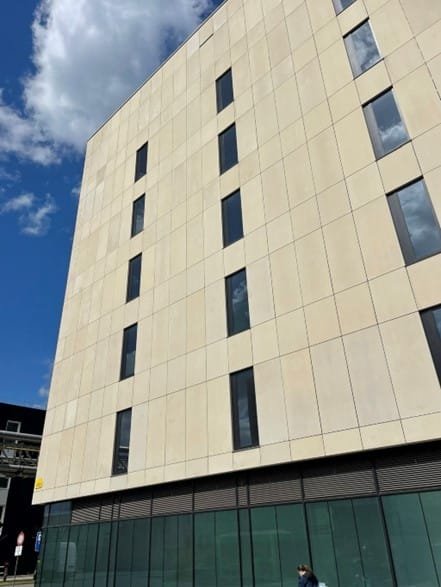
The building „D50“ on the Merck site is a heated, eight-story laboratory and office building with approximately 15,600 m²2 gross floor area.
The elevator shaft in the building currently is not equipped with a controlled smoke extraction or ventilation system, which is why heated room air escapes through the permanently open opening in the shaft or machine room.
The measurements are intended to shed light on whether retrofitting shaft smoke extraction systems is economically feasible and worthwhile.
In the case of the measurements under review, it is an elevator shaft with a group of two passenger elevators in building D50 of the company Merck in Darmstadt; a measuring device was temporarily installed at the smoke extraction opening of this building to determine the magnitude of the annual energy loss.
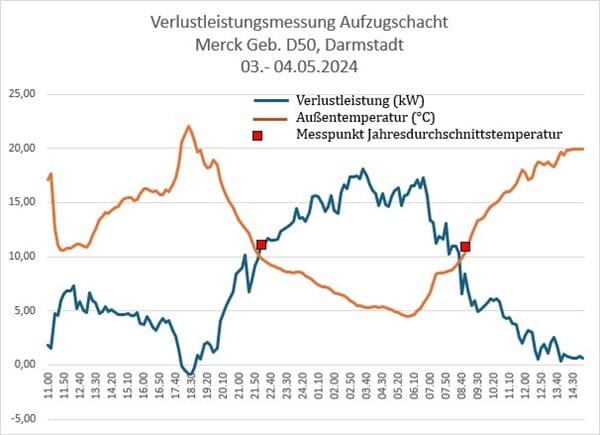
To this end, an anemometer (TSI VelociCalc 5725) was installed in the smoke extraction opening. The TSI VelociCalc 5725 records the flow velocity and temperature of the outgoing air. An additionally installed temperature logger (DK320) outside the building recorded the outdoor temperature over the measurement period.
The loss energy is calculated from the temperature difference and the volume flow:
Loss energy per year (kWh) = air loss volume per year (m3) x specific heat capacity of air 0.00033 (kWh/m3 K)
Note:
Heat energy losses occur when the outdoor temperature is lower than the indoor temperature of the building. The measurements were taken during a more advanced season; in parts of the measurement interval, the outdoor temperatures were even higher than the indoor temperatures of the building. Therefore, the measurement points marked in the measurement diagram are particularly significant, as the outdoor temperature is almost identical to the annual average temperature of Darmstadt (10.6 °C). Source: https://de.climate‐ data.org/europa/germany/hessen/darmstadt-2129/?utm_content=cmp-true) corresponded.
The elevator systems operating in the building have the following installation data:
Manufacturer: Thoma Aufzüge
Factory No.: PL195 Factory No. 3892 + PL196 Factory No. 3893 in common shaft Load capacity: 3000kg
Shaft height: 36.97 m Shaft depth: 3.23 m Shaft width: 4.94 m Stops: 8/7
Door type: Meiller, 4-leaf central opening
Door width: 1400mm
Door height: 2500mm
Number of doors: 28 (each in 7 stops)

Measurement of passenger elevators: group of two in a common shaft (serial no. 3892+3893)
Ø Volume flow 3,151.9 m3/h
Ø Internal temperature 19.80 °C
Ø Outdoor temperature 12.39 °C
Ø Power loss 7.92 kW (12.39°C outside temperature)
Derived from the annual average of outdoor temperature (10.60°C)
Ø Loss power 10.15 kWh
Annual energy loss derived from this is approximately 80,000 to 90,000 kWh
Depending on the heating energy emission factor, there is the possibility of reducing the emissions generated during building operation. Reduce CO₂ emissions by about 15t/year.
Conclusion
The measurement was conducted only over a short period of time, however under representative environmental conditions. The elevator was operating normally during the measurement, which is very important. Additionally, the outdoor temperature was within an acceptable range, which allows for a meaningful interpretation of the measurement results.
Of course, the results of this measurement cannot be readily transferred to any other elevator system.
However, for commercial considerations, it can be assumed that the average heat energy loss in an elevator shaft operating under comparable environmental conditions is between 50,000 and 80,000 kWh / year.
At a heating energy price of EUR 0.07/kWh net, the cost savings per elevator shaft amount to EUR 3,500 to 5,600 net per year.
Depending on the CO2 emission factor, this means CO2 savings of approx. 10–16 t CO2 per year per elevator shaft.
To provide you with an optimal experience, we use technologies such as cookies to store and/or access device information. If you consent to these technologies, we may process data such as browsing behavior or unique IDs on this website. If you do not consent or withdraw your consent, certain features and functions may be affected.
 English
 Deutsch